
Mental models, practiced daily
The stronger AI gets, the more you need your own mental models.
ConceptFlow gives you one mental model a day. Guess first, watch how it works, listen to a 5-minute audio lesson, then apply it to a choice you are actually facing.
Which book is more likely to still be in print 50 years from now?
For non-perishable ideas and books, every additional year of survival increases — rather than decreases — expected remaining lifespan.
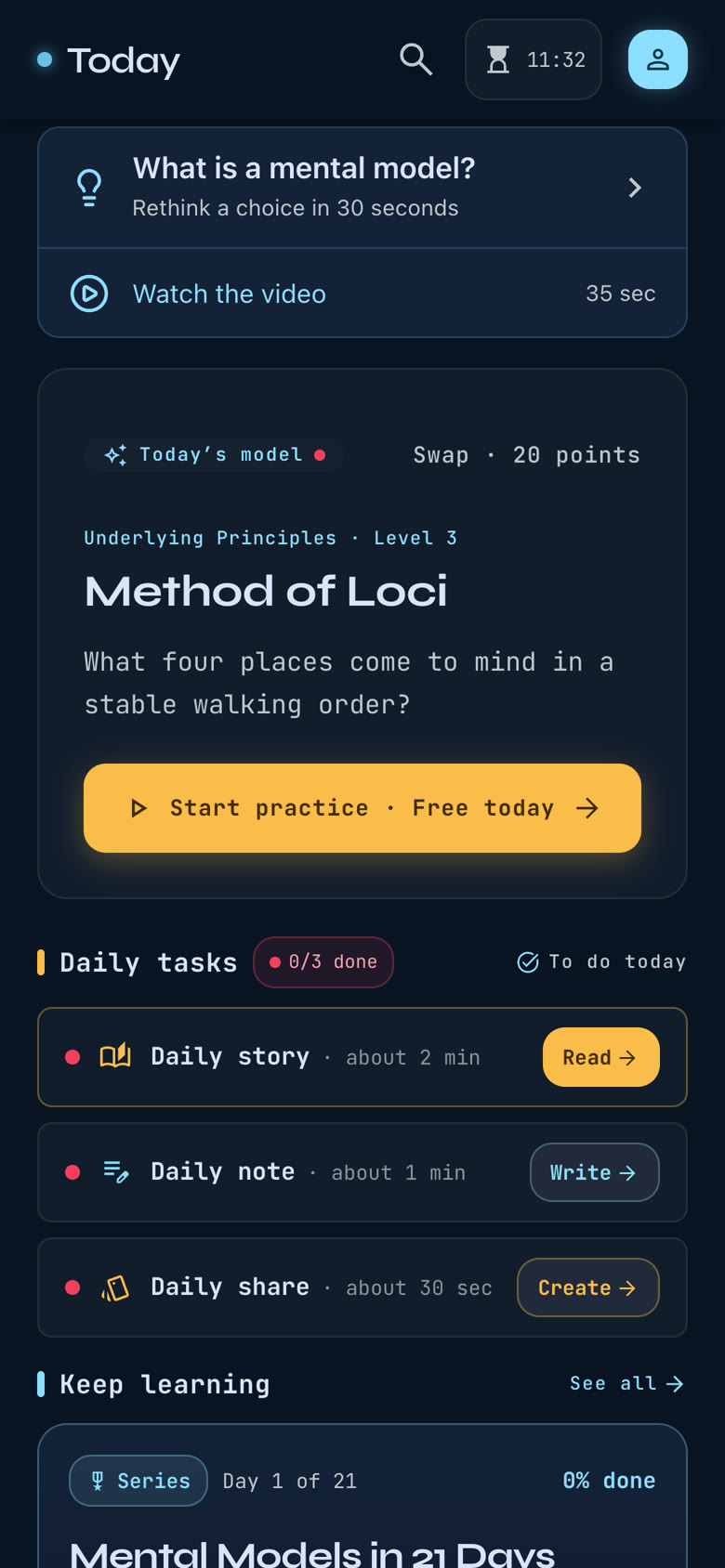
- Today’s model arrives with a question from ordinary life
- Three short daily tasks: a story, a note, a share
Open library
Start reading mental models right now
Every model in the ConceptFlow library has a clear definition, real-world case, failure boundaries, and a practical checklist.
Lindy Effect
The Lindy effect says that for things with no natural lifespan, expected remaining life is roughly proportional to the time they have already survived. A book read for a century will probably be read for a long time yet, while a bestseller from this year may be forgotten in five. It applies only to things that do not wear out; for people, food or machine parts it runs the other way.
“The Lindy effect says that for things with no natural lifespan, expected remaining life is roughly proportional to the time they have already survived. A book read for a century will probably be read for a long time yet, while a bestseller from this year may be forgotten in five. It applies only to things that do not wear out; for people, food or machine parts it runs the other way.”
Read model preview →Circle of Competence
Decide only where you have real expertise, and know its edge honestly.
Compounding
Small edges, compounded repeatedly over time, produce outsized nonlinear results.
Incentive-Caused Bias
"Show me the incentive and I’ll show you the outcome"—incentives silently shape behavior and belief.
Inversion
Invert: work out how to fail for certain, then avoid it.
Margin of Safety
Leave a buffer between estimate and reality to absorb error and surprise.
Opportunity Cost
The true cost of any choice is the best alternative you give up.
Start with These 5 Mental Models in 5 Days
Opportunity cost, inversion, second-order thinking and more, applied to one decision you are weighing
Mental Models in 21 Days
One a day: your first latticework in three weeks
Risk Thinking in 7 Days
Survive first, then win
30-second explainer with English narration and subtitles in five languages.
Why mental models
One way of thinking is rarely enough.
Charlie Munger
In a talk at the University of Southern California, Munger argued for borrowing mental models from many disciplines instead of leaning on one.
Read the talk →Daniel Kahneman & Amos Tversky
Their experiments showed that describing the same choice in different words can change what people decide.
Read the study →FIG. 01Practice
Think first, then see the answer
Practice runs in six steps. You commit to a guess before anything is explained, then watch the mechanism and put it in order yourself. Today’s model is free to practice.
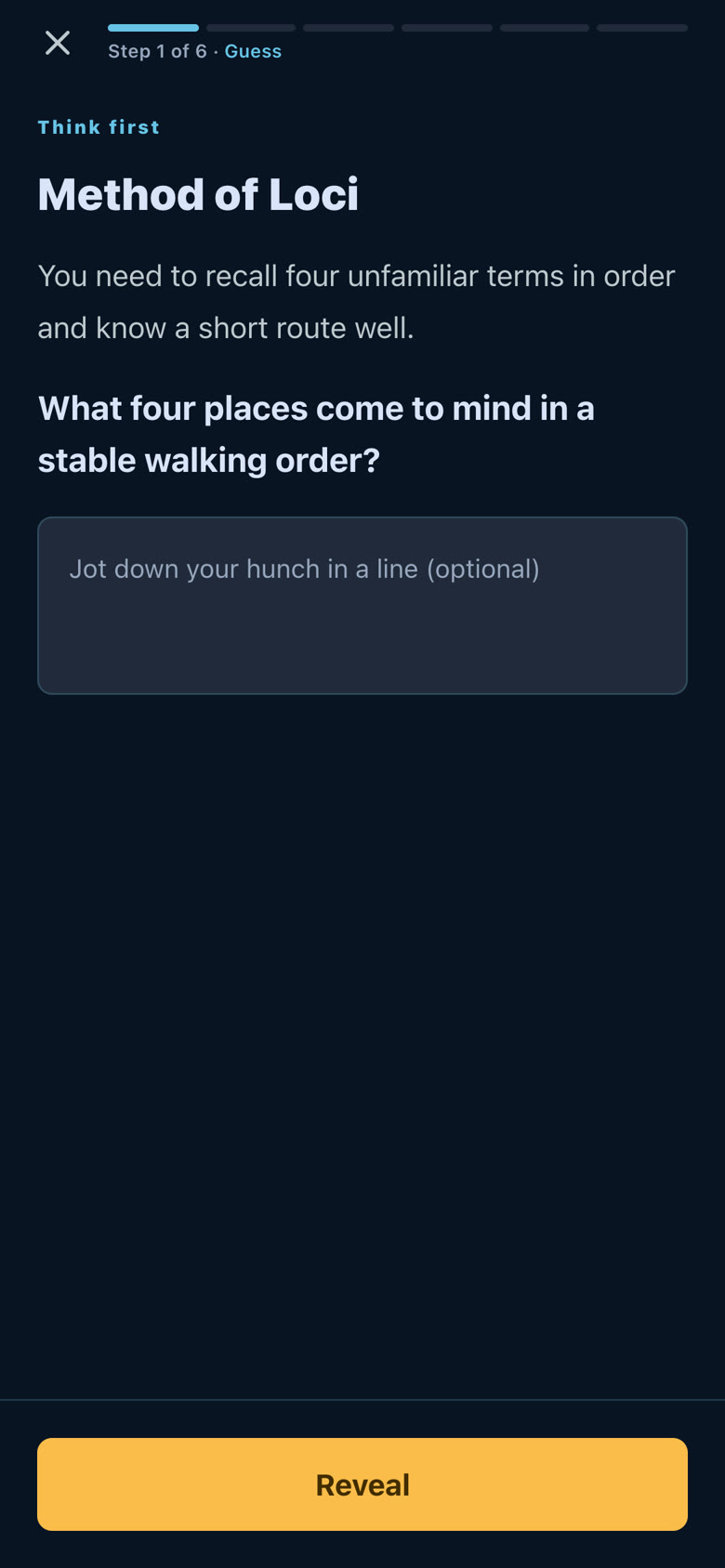
- A concrete question, before any explanation
- Write your hunch in one line
FIG. 02Mechanism
See how a model works
Every model page plays its mechanism as a short animation, next to the core rule, a story, examples, audio narration, and the ways the model gets misused.
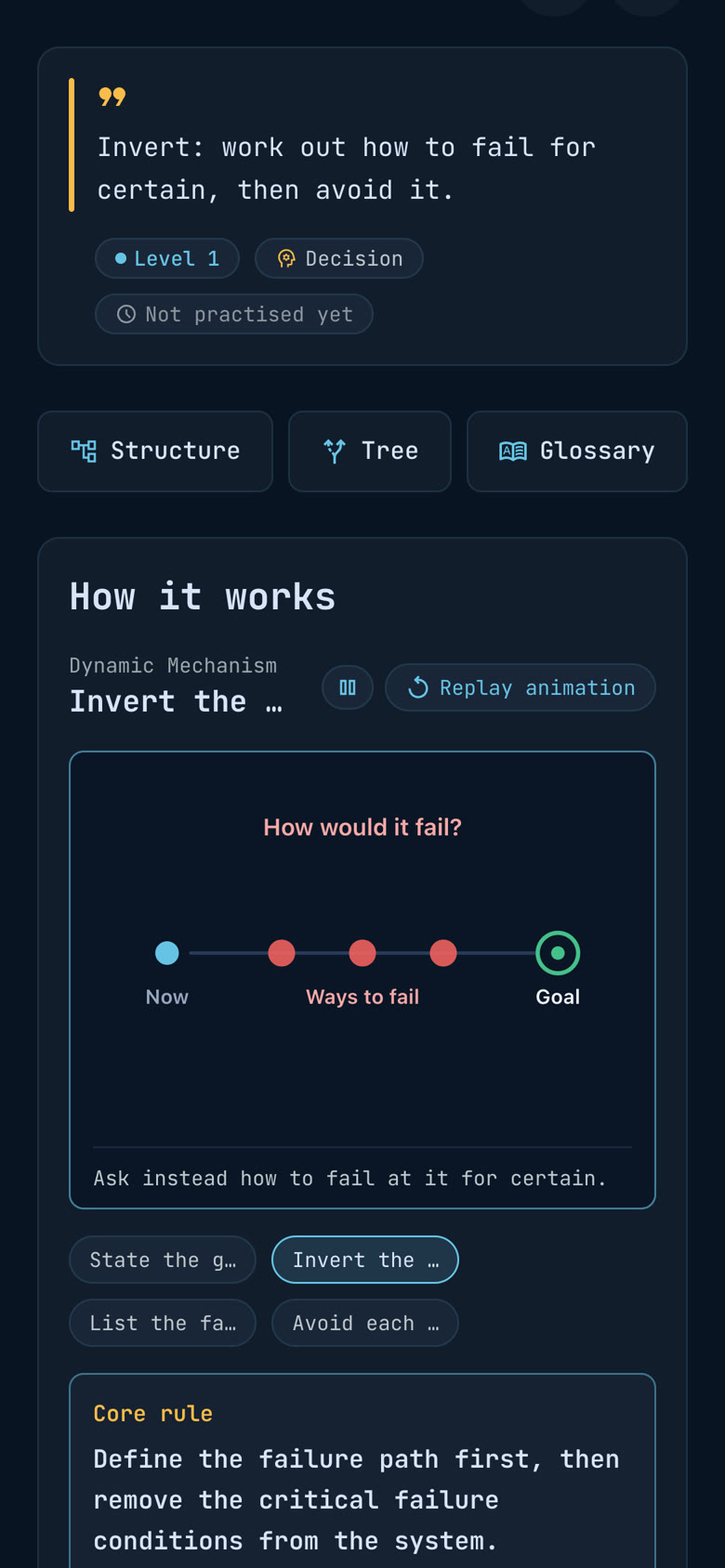
- The mechanism, animated step by step
- The core rule in one sentence
FIG. 03Library
1,246 models, organised into paths
Browse by theme, or follow a guided path such as Mental Models in 21 Days. The classics shelf groups models by the books they come from.
- Filter by decision, cognition, psychology, systems and more
- Guided learning paths, one model a day
- Classic books, from Poor Charlie’s Almanack to Thinking, Fast and Slow
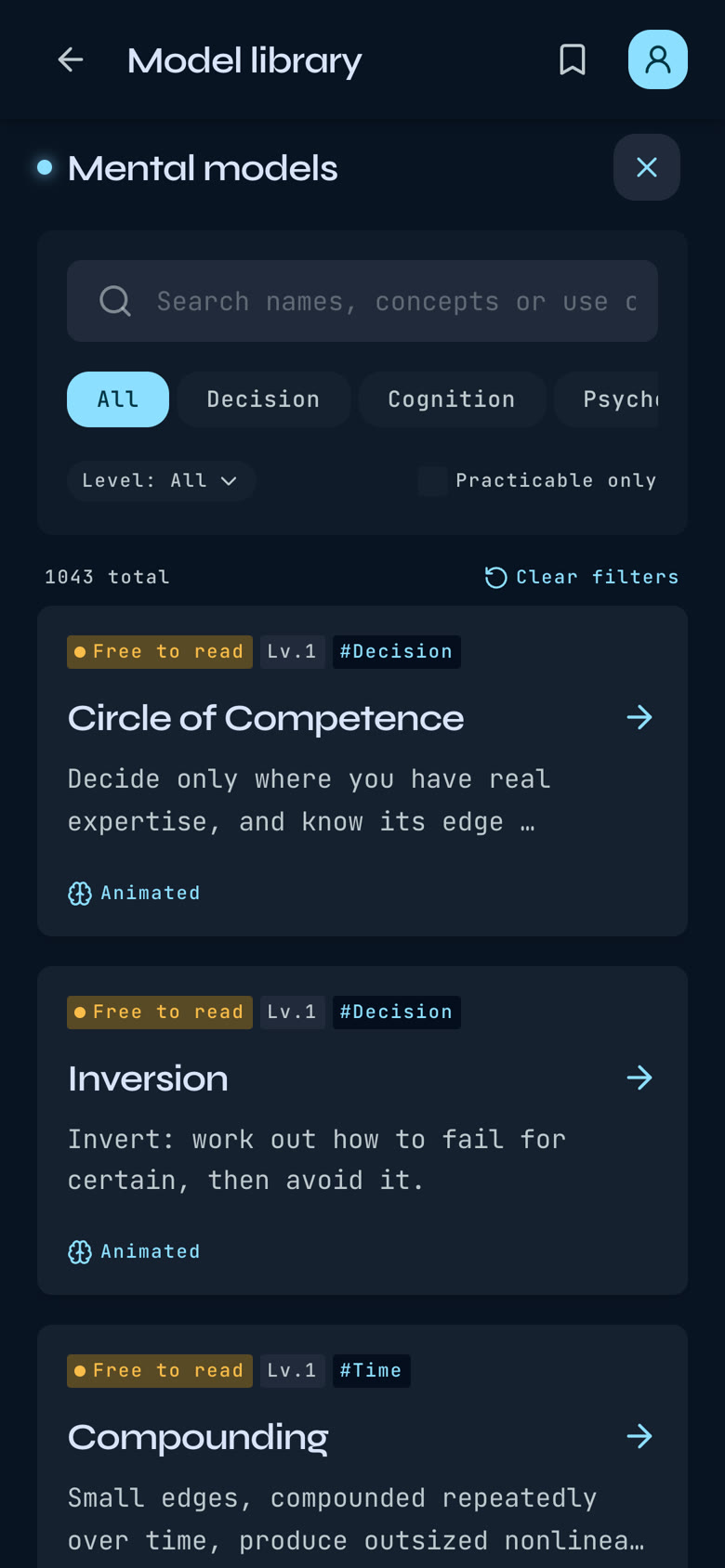
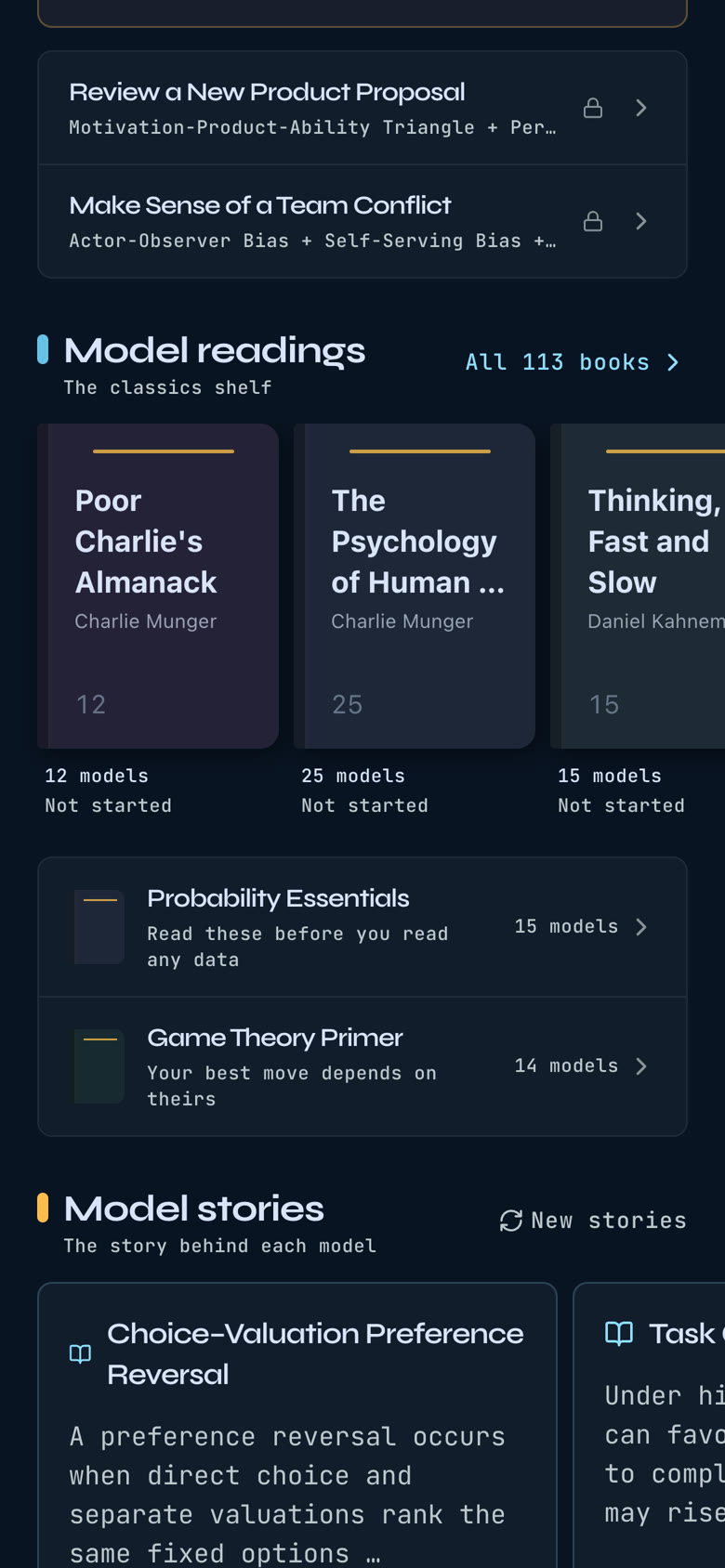
FIG. 04In action
Use it on real decisions
Toolkits chain several models around one problem. Make a Big Decision walks your own situation through six of them, from One-Way vs Two-Way Doors to Margin of Safety.
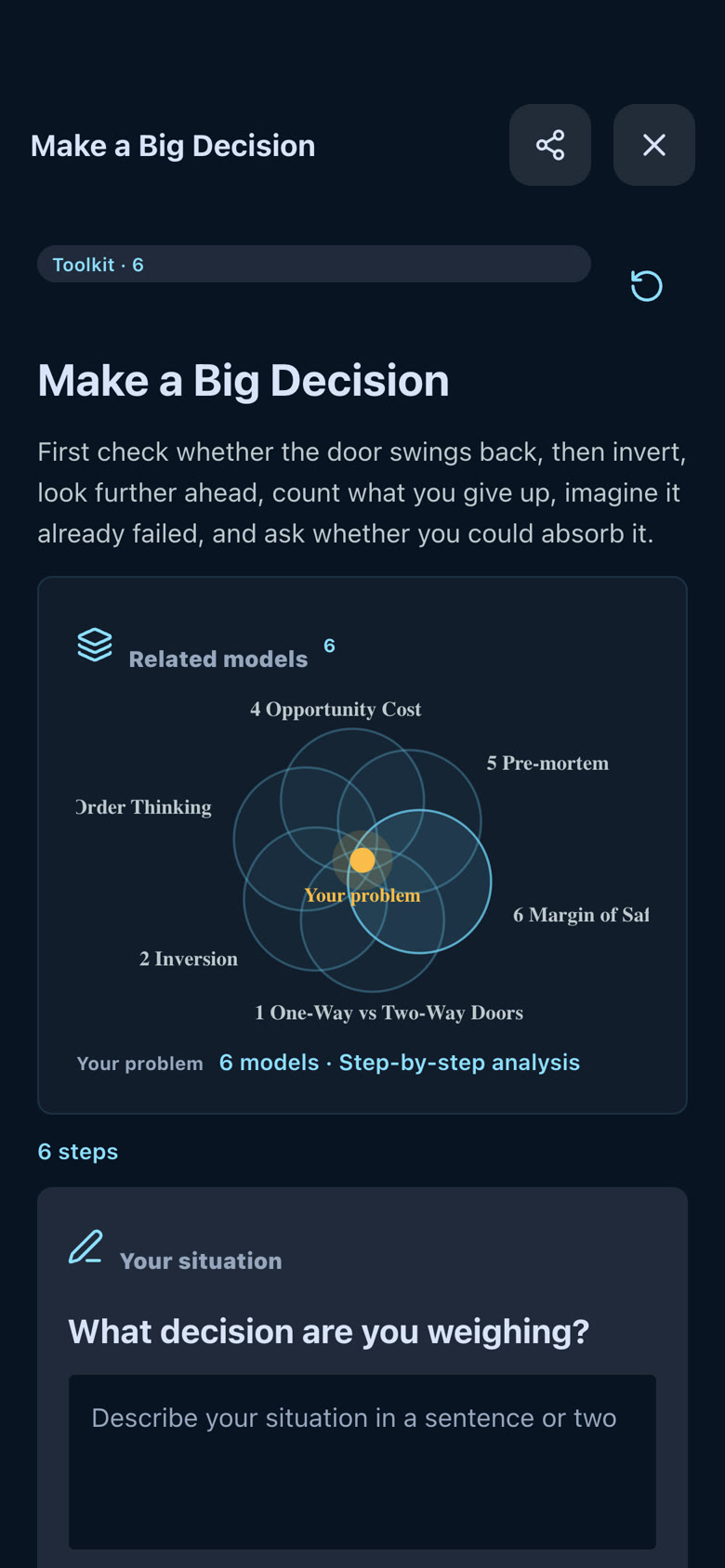
- Six models arranged around your problem
- You describe the situation, the toolkit asks the questions
Tour
The whole app in 30 seconds
No voice-over, just the screens you will use every day.
Get the app
Practice one model today.


Scan with your phone camera, or tap a button on this device.
Today’s model is free to practice, and ten selected models are free to read. Membership unlocks the rest of the library, audio lessons, learning paths and toolkits.
Your learning record is kept on your device, and you can export a backup.